
PGL Beyond’s new Skills 4 Life programme has been designed to equip disadvantaged youth with resilience, well-being and employment skills.
At PGL Beyond we understand how important a broad breadth of learning can be to a child’s development. But we also know that being from a disadvantaged background significantly increases a young person’s chance of becoming NEET (Not in Education, Employment or Training). Moreover, without any early intervention, a cycle of cumulative disadvantage, unemployment and poor mental health will prevail.
Notwithstanding the detrimental impact of structural inequality on young people’s future prospects, many manage to avoid the negative trajectories associated with multiple risk factors, demonstrating healthy biopsychosocial development that exceeds what their circumstances might predict. For instance, the recent Covid Inquiry commended children and young people for their resilience in continuing to learn despite unprecedented disruption to their daily lives.
Psychological resilience encompasses a range of learned, adaptive behaviours that help protect vulnerable children and young people from the developmental challenges that might otherwise arise from adverse circumstances. It is often cultivated through health-promoting and protective factors—at the individual level (e.g., self-regulation and self-esteem), within families and secure attachments (e.g., sociability and empathy), and through broader social and community values (e.g., education).
While resilience does not guarantee good mental health, it enables individuals to solve problems, manage setbacks, work conscientiously, communicate with people from diverse backgrounds, and adapt to changing conditions. These attributes are highly valued by prospective employers, arguably even more so than technical proficiencies.
Outdoor interventions build adaptive capacity
Immersion in natural settings has been shown to produce positive psychological outcomes in children and young people, fostering resilience and broader skill development. Exposed to uncertain, multisensory environments, individuals are challenged to engage directly with their surroundings, stimulating creative thinking, empathy, and problem-solving abilities.
We have seen that outdoor education programmes are most effective when they are designed to influence everyday life, are developmentally appropriate, progressively adaptable, and grounded in evidence-based practice. But, equally important is a sound theoretical framework supported by robust, valid, and reliable measures to justify and sustain these outcomes.
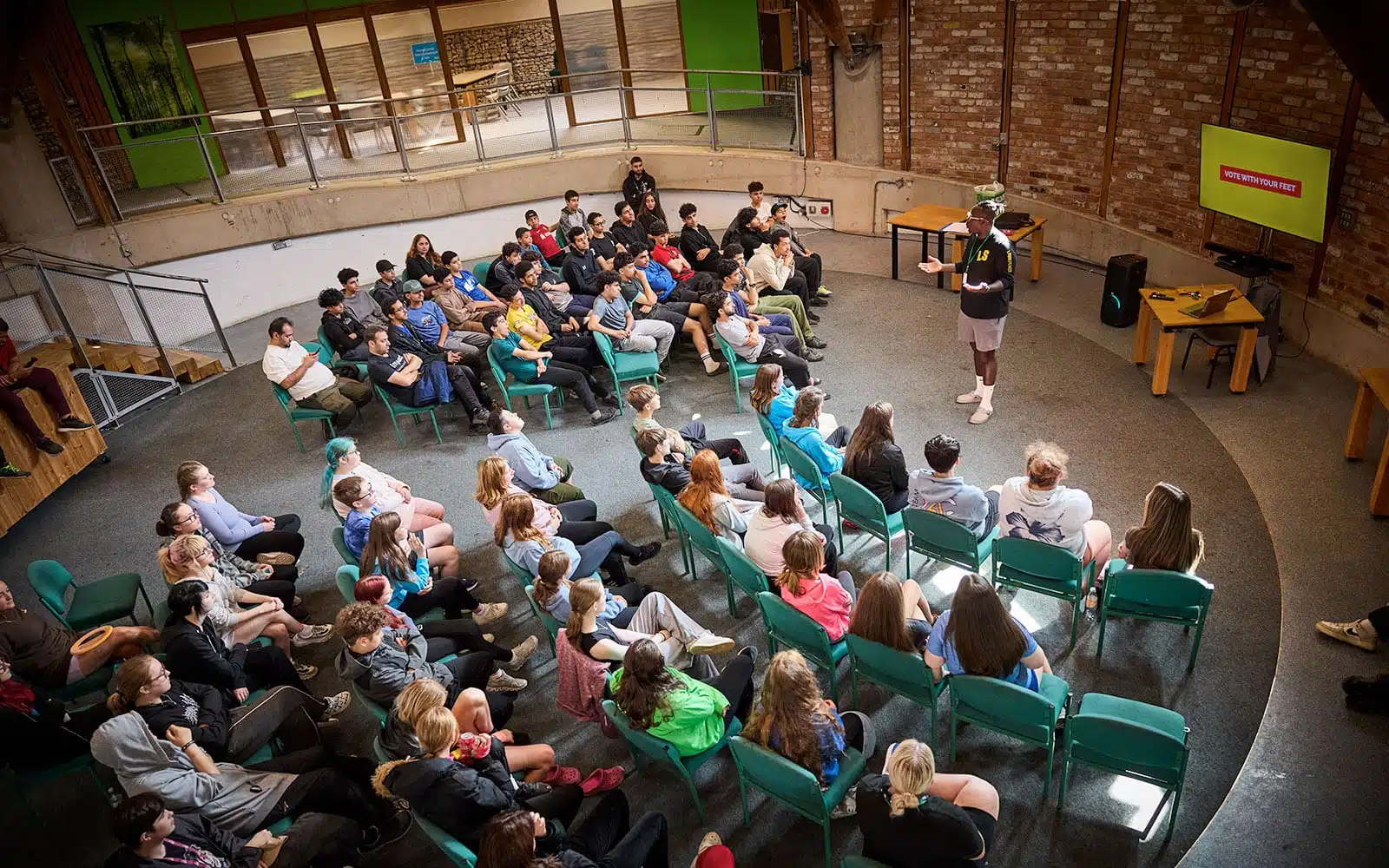
In alignment with these principles, we recently delivered two week-long outdoor residential pilot programmes called Skills 4 Life. These emphasised resilience-building as the overarching conceptual framework, purposefully designed to empower young people aged 14–17 to develop skills essential for future employment.
We received ethical approval by Sheffield Hallam University, the initial research project findings are encouraging, reflecting outcomes from a diverse cohort of more than 100 vulnerable young people recruited from schools, colleges, young carers’ groups, migrant organisations, and youth work charities.
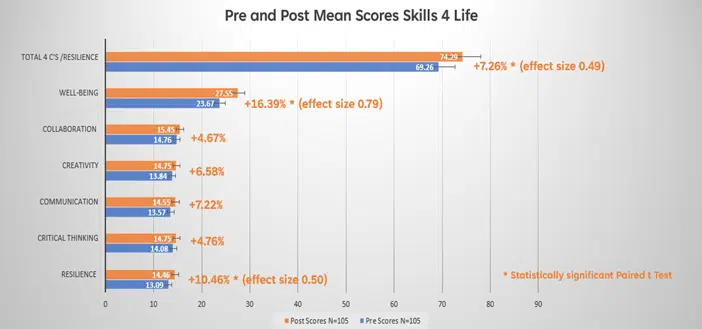
In contrast to equivalent non-attendees, participants collectively reported increases in resilience, subjective well-being, and vocational skills—specifically the “Four Cs”: Collaboration, Critical Thinking, Creativity, and Communication (see graph below). Follow-up measures for each of these variables will be collected one month after programme completion.
Vocational skills integration
Throughout the week, outdoor activities were integrated with vocational skills training designed by experts in nutrition, public speaking, digital literacy, and financial management. Supported by a team of instructors, youth workers, and pastoral care staff, participants tracked their progress using the accredited, universal Skills Builder Framework of “I can” statements, tailored to the learners age range.Statements such as “I analyse cause and effect” and “I question my own ideas to improve them” were evidenced through reflective practice and goal-setting exercises recorded in personal journals. These journals were retained by participants as a resource to support future employment opportunities. Sample qualitative reflections reported within the journals included the following:
‘I learnt to tell people about myself – what I love, my challenges, failures and successes, I learnt to not back down from my fears’
‘Skills 4 Life showed me that life is like a bumpy road, we will face hardships along this road, but we can conquer them’
‘I learnt that a leader isn’t a person who craves power, but a leader is one who steps up, who supports others and does it for nothing’
‘My goals have been looking out for others and being happy’
‘Even though my arms are too short and I couldn’t reach the rope I had a fab day’
Bringing Skills 4 Life, to life
Whilst with any pilot study involving a small sample within an evolving programme should be viewed with caution, the consistent positive outcomes across multiple mixed measures provide proof of concept, and validate both the approaches adopted and the evaluation tools employed. Building on this evidence base, we will be developing and refining the programme with partners and scaling up accordingly.
Since one quarter of the million NEETs aged 16–24 are inactive due to disability or ill health, collaborative efforts to design and implement accessible interventions that enhance adaptive functioning must be central to our approach. Alongside policies to embed more vocationally relevant skills and enrichment into the National Curriculum, purpose-led, robust outdoor programming—such as that reported here—has perhaps never been more vital for helping to optimise positive youth development.
Dr John Allan, Head of Impact and Breakthrough Learning PGL Beyond